
Technology
Batch Analysis Ahrefs: The Complete Guide to Bulk SEO Analysis

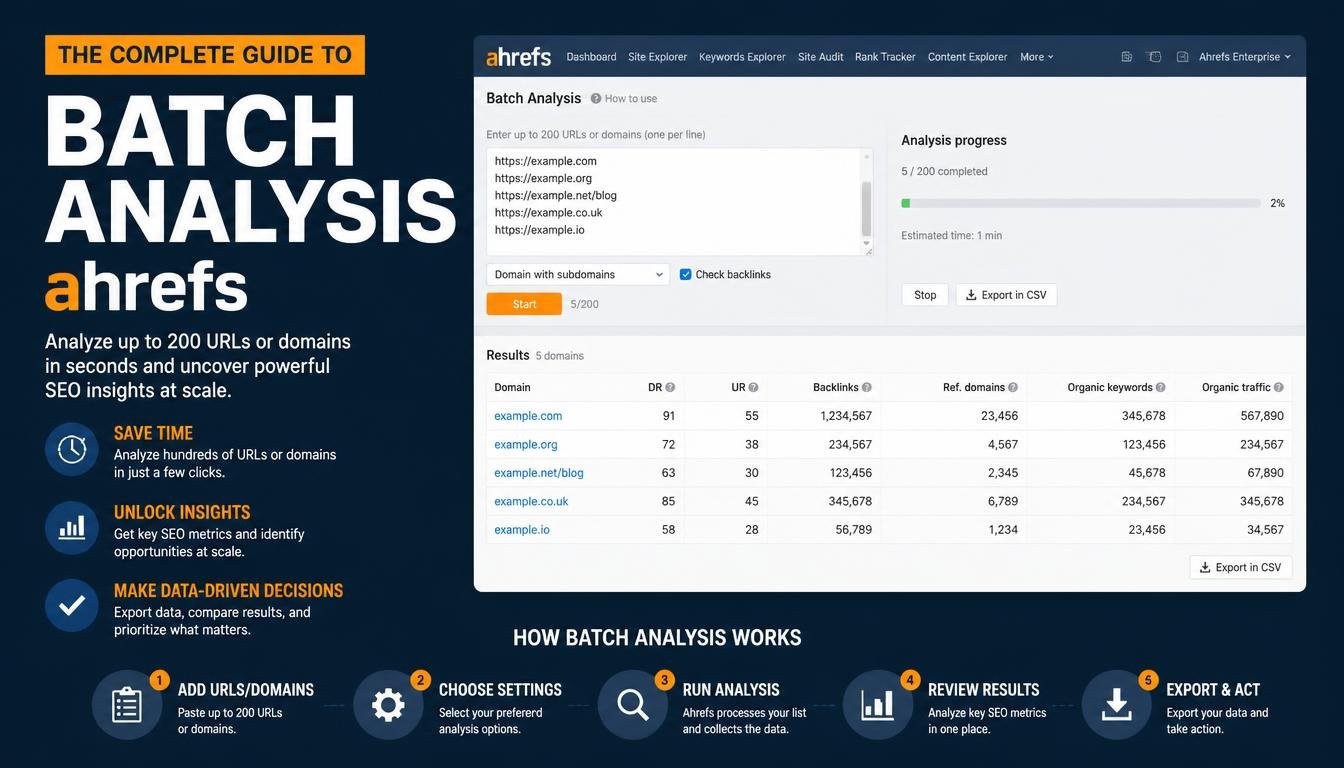
SEO research can become extremely time-consuming when you need to analyze dozens or hundreds of websites and URLs individually. Instead of opening one report after another, copying metrics into a spreadsheet, and repeating the same process over and over again, Ahrefs Batch Analysis allows SEO professionals, website owners, agencies, marketers, and link builders to analyze multiple URLs or domains in a single workflow. The tool is particularly useful when you need to compare backlink profiles, Domain Rating, URL Rating, organic search performance, referring domains, traffic estimates, and other SEO metrics across a large list of targets. Ahrefs describes Batch Analysis as a bulk SEO analysis and backlink-checking tool that can process many individual URLs and allows users to work with the resulting report in the browser or export the information as a CSV file.
The real value of batch analysis in Ahrefs is not simply that it produces a large amount of SEO data. Its biggest advantage is that it makes comparison much faster and easier. For example, imagine that you have collected 50 competitor pages ranking for an important keyword and want to determine which pages have the strongest backlink profiles. Checking every page separately would take considerable time and make it harder to compare the results consistently. With Ahrefs Batch Analysis, you can place your target URLs into one report and examine important SEO metrics together.
What Is Ahrefs Batch Analysis?
Ahrefs Batch Analysis is a feature designed to analyze multiple websites or URLs simultaneously instead of requiring you to inspect each target individually. You provide a list of URLs or domains, and Ahrefs generates a report containing SEO metrics for those targets. According to Ahrefs, the report can include Ahrefs Rank, Domain Rating, referring domains, backlinks, social metrics, and other SEO information. The current Ahrefs Help Center also lists metrics covering URL Rating, organic keywords, estimated traffic, traffic value, paid-search information, referring IPs, backlinks, and outgoing links.
This makes Batch Analysis different from using Ahrefs only for one website at a time. Traditional SEO analysis often involves opening Site Explorer for a competitor, recording its metrics, opening another competitor, recording those metrics, and then repeating the process for every target. Batch Analysis changes that workflow by putting multiple targets into one report. This is especially valuable when the objective is comparison rather than deep investigation of a single website. You can use the bulk data as a first stage of research and then move into other Ahrefs tools when you identify a domain, page, or competitor that deserves a more detailed investigation.
Why Is Batch Analysis Important for SEO?
The main reason SEO professionals use bulk analysis is efficiency. SEO decisions are often based on patterns rather than isolated numbers, and those patterns become much easier to identify when comparable websites or pages are placed next to each other. If you are researching competitors, for example, you may want to know whether the pages ranking above your content have significantly stronger backlink profiles, more referring domains, higher URL Ratings, or stronger organic search visibility. Looking at these factors individually can provide useful information, but looking at them across a complete group of competing pages can reveal much more meaningful patterns.
Batch Analysis can also help reduce repetitive manual work. A marketer performing outreach may have a list of hundreds of potential websites and want to prioritize the strongest prospects. A content strategist may have a collection of competing articles and want to compare their SEO strength. An agency may need to prepare a large competitor analysis for a client. A publisher may want to investigate the backlink profiles of many pages in a particular search result. In each situation, the ability to analyze many targets in one report can make the research process considerably more efficient. Ahrefs also allows report data to be exported as CSV, which means the information can be combined with spreadsheets and other analysis workflows.
How to Use Ahrefs Batch Analysis
Using Ahrefs Batch Analysis starts with collecting the URLs or domains that you want to investigate. Your list might contain competitor websites, individual ranking pages, potential link prospects, client websites, or any other SEO targets that you want to compare. The important point is to define the purpose of the analysis before collecting the URLs, because the most useful metrics depend on what you are trying to accomplish. For example, backlink prospecting requires a different interpretation of the data than competitor research, and analyzing individual pages requires more attention to URL-level metrics than a domain-level comparison.
After preparing your target list, enter the URLs or domains into Batch Analysis and run the report. Ahrefs then returns a table containing the available SEO metrics for your targets. The current Help Center documentation lists URL Rating, Ahrefs Rank, Domain Rating, organic keyword counts, traffic, traffic value, top location information, paid-search metrics, referring domains, referring IPs, backlinks, and outgoing-link data among the available metrics. Once the report is generated, you can review the results directly in Ahrefs or export the data to CSV for further analysis. This makes it possible to sort, filter, compare, and organize the information according to the specific SEO question you are trying to answer.
Ahrefs Batch Analysis Metrics You Should Understand
One of the most important parts of using Batch Analysis effectively is understanding what each metric actually tells you. A common mistake is to look at one number, such as Domain Rating, and assume that it represents the complete SEO strength of a website or page. In reality, SEO performance involves many different signals, and the most useful analysis usually considers several metrics together.
Domain Rating (DR)
Domain Rating, commonly abbreviated as DR, is an Ahrefs metric associated with the strength of a website’s backlink profile. When comparing domains, DR can provide a useful high-level indication of how strong their link profiles are relative to other domains in the Ahrefs ecosystem. It can be particularly useful when you are performing competitor research or evaluating potential websites for link-building opportunities.
However, DR should not be treated as a direct Google ranking score. A website with a high DR does not automatically rank higher for every keyword, and a low-DR website can still rank successfully for particular topics. Search intent, content quality, topical relevance, internal linking, technical SEO, competition, and many other factors can affect search performance. Therefore, use DR as one comparative metric rather than as a final judgment about whether a website is valuable.
URL Rating (UR)
URL Rating, or UR, focuses on the strength of a specific URL’s backlink profile. This makes UR especially useful when you are comparing individual pages rather than entire domains. For example, if you are researching the top-ranking pages for a keyword, looking at the UR of those individual pages can help you understand the relative strength of their link profiles.
UR can be particularly useful for content and competitor research because a strong domain does not necessarily mean that every page on that domain has a strong backlink profile. A website may have an impressive overall DR while a particular article has very few external links. Conversely, an individual page may have accumulated a substantial number of backlinks even if the overall domain is not exceptionally strong.
Ahrefs Rank (AR)
Ahrefs Rank, or AR, is another metric available in Batch Analysis. It provides an Ahrefs-based ranking of domains according to the strength of their backlink profiles. It can be useful when comparing large groups of websites and identifying which domains appear stronger within Ahrefs’ link database.
Like DR, AR should be interpreted as an SEO research metric rather than a Google ranking factor. It is most useful when combined with other information, particularly organic search data and backlink metrics.
Referring Domains
Referring domains represent the number of unique domains linking to a target. This metric can be more informative than simply looking at the total number of backlinks because hundreds of links from one website are not the same as links from hundreds of independent websites.
When comparing competitors, examining referring domains can help you understand the breadth of their backlink profiles. If several pages competing for the same topic have substantially more referring domains than your page, that may indicate that link acquisition is an important part of the competitive landscape. However, quantity should never be considered separately from relevance and quality.
Backlinks
The backlinks metric shows the total number of links pointing toward the target according to Ahrefs’ data. Backlinks remain an important part of SEO analysis, but a large backlink count does not automatically indicate a strong or healthy link profile. A website can have thousands of backlinks generated from a small number of domains, while another website may have fewer total backlinks but links from a broader and more relevant group of websites.
For this reason, backlink analysis should normally consider total backlinks, referring domains, followed links, and the context and relevance of the linking websites rather than relying on one number.
Organic Keywords
Batch Analysis can also provide information about the number of organic keywords for which a target ranks. The current Ahrefs Help Center documentation includes total organic keywords and keyword-position groupings such as top 3, positions 4–10, positions 11–20, 21–50, and 51+.
This information can be extremely useful for competitor analysis. A competitor ranking for thousands of keywords may have broad search visibility, while another competitor may rank for fewer keywords but dominate a smaller and more valuable topic area. Looking at keyword counts alongside traffic estimates can therefore provide more context than keyword counts alone.
Organic Traffic and Traffic Value
Ahrefs Batch Analysis can provide estimated organic traffic and traffic value information. These figures can help you compare the search visibility of multiple targets and identify which competitors appear to receive more organic search exposure.
It is important to remember that third-party SEO platforms provide estimates rather than the private Google Analytics or Google Search Console data of another website. Therefore, estimated traffic should be used for comparative research and directional decision-making rather than treated as an exact measurement of a competitor’s actual visits.
Referring IPs and Subnets
Batch Analysis also includes referring IP and subnet information. These metrics can provide another layer of context when evaluating backlink profiles. They may help you identify whether a backlink profile is spread across a diverse collection of sources or concentrated within a smaller network of related infrastructure.
These metrics are generally more useful for advanced SEO investigations than for basic competitor comparisons. Most beginners should first understand referring domains, backlinks, DR, UR, and organic search metrics before relying heavily on IP-level information.
Outgoing Links
The Batch Analysis report can also provide information about outgoing links and linked domains. This can be useful when researching websites from a link-building or competitive perspective because it gives you additional information about how a target site connects to other domains.
For example, if you are investigating potential outreach prospects, understanding a website’s existing outbound-link behavior can help you determine whether it regularly links to external resources. That information can be combined with topical relevance, website quality, and other factors when deciding which prospects deserve attention.
Ahrefs Batch Analysis for Competitor Research
One of the strongest use cases for Batch Analysis is competitor research. Suppose you have identified ten pages that consistently appear in search results for an important keyword. Instead of opening every page individually, you can place the URLs into Batch Analysis and compare their SEO metrics. This can help you identify patterns in Domain Rating, URL Rating, referring domains, backlinks, organic keywords, and estimated traffic.
The important part is not simply finding the competitor with the highest number. Instead, look for patterns across the entire competitive set. If most ranking pages have significantly stronger referring-domain profiles than your page, link acquisition may be one area worth investigating. If competitors have relatively similar backlink strength but much larger organic keyword coverage, content depth and topical coverage may deserve more attention. If one page performs exceptionally well despite having relatively modest link metrics, examine its content quality, search intent alignment, internal linking, brand strength, and SERP characteristics before assuming that backlinks are the primary reason it ranks.
Using Batch Analysis for Link Building
Link builders can use Ahrefs Batch Analysis to evaluate large lists of potential websites quickly. Imagine that you have collected 200 websites that appear relevant to your industry and want to determine which ones should receive outreach first. Rather than researching each website individually from the beginning, you can use Batch Analysis to collect comparable metrics and create an initial prioritization system.
A useful approach is to combine several factors rather than selecting prospects solely according to DR. You might consider topical relevance first, then examine referring domains, organic visibility, traffic estimates, backlink characteristics, and other available metrics. A highly relevant website with a genuine audience and strong organic visibility may be a better prospect than a site with a very high DR but little relevance to your subject. The purpose of Batch Analysis is to make the initial filtering process faster; it should not replace human judgment about whether a website is actually worth contacting.
Using Batch Analysis for Content Research
Content marketers can also use Batch Analysis to study competing articles at scale. If you are preparing a comprehensive article on a competitive topic, you can collect URLs from relevant search results and compare their SEO metrics. This allows you to understand the general authority and link environment of the pages that already perform well.
The next step is to move beyond metrics and study the actual content. Look at what topics competitors cover, what questions they answer, how their pages are structured, which subtopics repeatedly appear, and where there are obvious gaps. Batch Analysis can tell you which pages have strong SEO metrics, but it cannot by itself tell you why users prefer one article over another. The strongest content strategy combines quantitative SEO data with qualitative analysis of search intent and content quality.
Using Batch Analysis for Bulk Backlink Analysis
A major reason people search for Ahrefs Batch Analysis is the ability to inspect backlink-related metrics across multiple targets. If you have a list of competitor URLs, for example, you can compare their backlink totals and referring-domain counts without opening separate reports for every page.
This is particularly valuable when analyzing a group of pages that compete for the same keyword. Instead of asking whether one competitor has backlinks, you can ask a more useful question: what does the backlink landscape look like across the entire group? If the top-ranking pages consistently have strong and diverse referring-domain profiles, you have evidence that link authority may be an important competitive factor. If backlink metrics vary widely while the pages still perform well, you should investigate other ranking factors rather than assuming that more backlinks are the solution.
Batch Analysis vs. Individual Site Explorer Research
Batch Analysis and Site Explorer serve different purposes. Batch Analysis is designed for efficient comparison across multiple targets, while a more detailed individual investigation can be performed when you need deeper information about one website or URL. This means that the two approaches work well together rather than competing with each other.
A practical SEO workflow might begin with Batch Analysis. You could collect 50 competitor URLs, run the bulk report, identify the strongest and most interesting targets, and then investigate those selected websites individually using other Ahrefs reports. This approach prevents you from spending significant time performing deep analysis on every URL when only a smaller number of targets are truly important.
How Many URLs Can Ahrefs Batch Analysis Handle?
The number of targets you can analyze depends on your Ahrefs subscription. Ahrefs’ current Help Center states that the Batch Analysis maximum is 200 targets for Standard, 500 for Advanced, and 1,000 for Enterprise. It also notes that Batch Analysis is available for new Standard plans and higher.
Because Ahrefs can change plans, limits, and product capabilities over time, it is sensible to verify the current limits in the Ahrefs account or Help Center before planning a large-scale workflow. This is particularly important for agencies and SEO professionals who need to process hundreds or thousands of URLs regularly.
How to Get Better Results From Ahrefs Batch Analysis
The quality of your Batch Analysis depends heavily on the quality of your target list. Do not simply collect as many URLs as possible and assume that a larger report will automatically produce better insights. Start by defining the question you want the data to answer. If you are analyzing competitors, collect genuinely relevant competitors. If you are researching backlinks, focus on websites and pages that have a realistic relationship with your niche.
You should also avoid making decisions based on a single metric. DR, UR, backlinks, referring domains, organic keywords, and traffic estimates each describe different aspects of SEO performance. A website with a high DR but weak topical relevance may be less useful to you than a moderately authoritative website that is highly relevant to your industry. Similarly, a page with many backlinks may not be a good competitor if those links are irrelevant or if the page does not match the search intent you are targeting.
Exporting Ahrefs Batch Analysis Data
Another useful feature of Batch Analysis is the ability to work with the report outside the Ahrefs interface. Ahrefs states that users can export the data into a CSV file and use it with another analysis tool. This can be helpful when your SEO process involves spreadsheets, databases, reporting systems, or custom calculations.
For example, an agency could export a competitor report and add additional columns for keyword difficulty, content type, business relevance, outreach priority, or notes from a manual review. A content team could combine SEO metrics with editorial information to determine which competitors deserve the most detailed analysis. The key is to use the exported data as part of a broader decision-making process rather than treating the CSV as the final answer.
Common Mistakes When Using Ahrefs Batch Analysis
One of the most common mistakes is assuming that higher DR automatically means better SEO performance. DR is useful, but it is not Google’s ranking score and should not be treated as one. Another common mistake is focusing on total backlinks without looking at referring domains. A page can have a very large number of backlinks while receiving most of them from a small number of websites, which tells you something different from having links from many independent referring domains.
Another mistake is ignoring search intent. You can find a competitor with impressive SEO metrics and attempt to copy its backlink strategy, only to discover that the real reason it performs well is that its content is a better match for what searchers want. SEO metrics are valuable for identifying patterns and opportunities, but they do not replace analysis of content, relevance, user intent, website structure, internal linking, brand reputation, and the overall quality of the search experience.
A final mistake is assuming that estimated traffic from an SEO tool is exact. Ahrefs provides useful estimates for comparative research, but competitors do not give you access to their private analytics. Treat estimated traffic as a directional metric and combine it with other evidence before making important business decisions.
Is Ahrefs Batch Analysis Worth Using?
For anyone who regularly compares multiple websites or URLs, Ahrefs Batch Analysis can be a highly useful part of an SEO workflow. Its main advantage is efficiency: instead of repeating similar research tasks for every individual target, you can collect comparable metrics in a single report. This becomes increasingly valuable as the number of URLs grows, particularly for agencies, link builders, content teams, affiliate marketers, publishers, and SEO professionals performing competitor research.
The tool is most valuable when you know what you are trying to discover. If you simply collect metrics without a specific research question, you may end up with a spreadsheet full of numbers but no clear strategy. If you use the data to answer specific questions—such as which competitors have the strongest referring-domain profiles, which pages have unusual backlink strength, which websites are promising outreach prospects, or which competitors have the greatest organic visibility—the information becomes much more actionable.
Ahrefs Batch Analysis Best Practices
A strong Batch Analysis workflow should begin with a clearly defined objective, followed by a carefully selected list of URLs or domains. Once the report is generated, compare multiple metrics rather than focusing on one number. Use DR for domain-level comparison, UR when individual page strength matters, referring domains to understand link-source diversity, backlinks to understand overall link volume, and organic search metrics to understand visibility. After identifying important targets, move into deeper analysis rather than trying to answer every SEO question from the batch report alone.
It is also important to keep your data organized. If you perform the same type of analysis regularly, create a repeatable spreadsheet or reporting structure with fields for target URL, target domain, DR, UR, referring domains, backlinks, organic keywords, traffic estimates, relevance, content type, and your own priority score. This turns Batch Analysis from a one-time research feature into a repeatable SEO research system that can save time across future projects.
Conclusion
Ahrefs Batch Analysis is a powerful solution for SEO professionals who need to analyze multiple URLs or domains without repeating the same research process over and over again. By bringing authority metrics, backlink information, referring-domain data, organic keyword information, traffic estimates, and other SEO signals into one report, the tool can make competitor research, content research, link-building analysis, and large-scale SEO investigations considerably more efficient. Ahrefs itself positions Batch Analysis as a bulk SEO analysis tool and provides the ability to export the resulting data for additional analysis.
The most effective way to use Batch Analysis is not to chase the highest metric or assume that one number explains Google’s rankings. Instead, use the tool to identify patterns, compare relevant competitors, discover promising opportunities, and decide where deeper research should take place. Combine DR and UR with referring domains, backlinks, organic visibility, search intent, content quality, and topical relevance, and you can turn a large collection of SEO data into meaningful strategic insights. When used this way, Ahrefs Batch Analysis becomes more than a bulk URL checker—it becomes a practical research layer that can help you work faster, evaluate competitors more systematically, and make better-informed SEO decisions.
Frequently Asked Questions About Ahrefs Batch Analysis
What is Batch Analysis in Ahrefs?
Batch Analysis is an Ahrefs feature that allows you to analyze multiple URLs or domains in one report. Instead of researching each target individually, you can enter a list of targets and receive a range of SEO metrics, including backlink, referring-domain, authority, and organic-search information.
What metrics does Ahrefs Batch Analysis provide?
The current Ahrefs Help Center lists metrics including URL Rating, Ahrefs Rank, Domain Rating, organic keyword counts, traffic, traffic value, top location data, paid-search metrics, referring domains, referring IPs, backlinks, and outgoing links. The exact data available can depend on the current Ahrefs product configuration and plan.
Can I analyze multiple URLs with Ahrefs Batch Analysis?
Yes. The purpose of Batch Analysis is to analyze multiple websites or URLs in a single report. The number of targets depends on your subscription level. Ahrefs currently lists 200 targets for Standard, 500 for Advanced, and 1,000 for Enterprise in its Help Center documentation.
Can Ahrefs Batch Analysis check backlinks?
Yes. Backlink information is one of the major uses of Batch Analysis. Ahrefs lists total backlinks, followed backlinks, not-followed backlinks, redirect links, and internal links among the available backlink-related data.
Can I export Ahrefs Batch Analysis data?
Yes. Ahrefs states that Batch Analysis reports can be exported as CSV files, allowing you to continue working with the information in spreadsheets or other analysis tools.
Is Ahrefs Batch Analysis good for competitor research?
Yes. It is particularly useful when you need to compare a group of competitors or competing pages. You can compare authority, backlinks, referring domains, organic keywords, and traffic estimates to identify patterns that may require deeper investigation.
Is Domain Rating the same as a Google ranking score?
No. Domain Rating is an Ahrefs metric used to describe the strength of a website’s backlink profile. It should not be interpreted as an official Google ranking score or as a guarantee that a website will rank higher in Google.
Is Batch Analysis useful for link building?
Yes. Batch Analysis can help link builders quickly evaluate large lists of potential prospects. However, metrics should be combined with topical relevance, editorial quality, organic visibility, and the likelihood that the website is genuinely appropriate for your outreach campaign.
Can Batch Analysis guarantee higher Google rankings?
No SEO tool can guarantee higher Google rankings. Batch Analysis provides research data that can help you understand competitors, backlinks, organic visibility, and other SEO characteristics, but ranking improvements depend on many factors and require an effective overall SEO strategy.
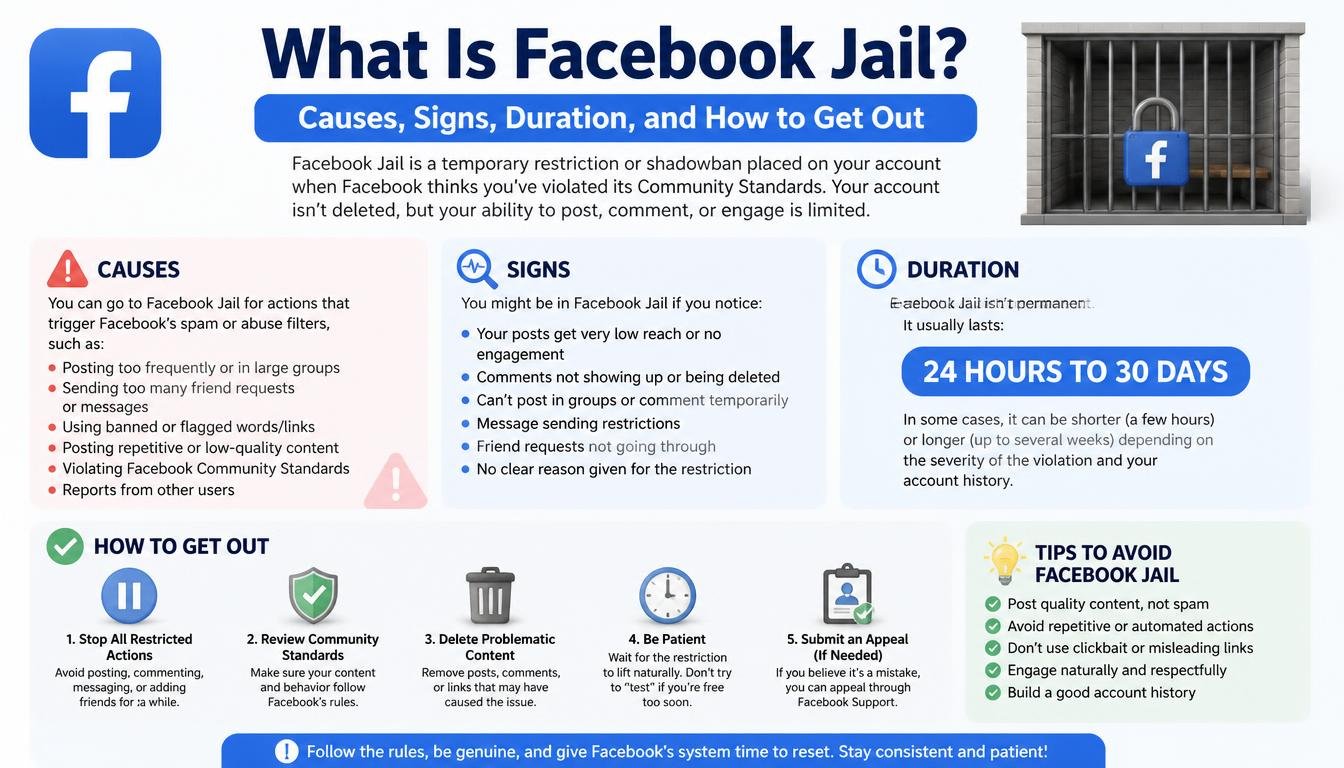
If you use Facebook regularly, you may have heard people say that they have been put in “Facebook jail.” But what is Facebook jail, and what does it actually mean? Facebook jail is an informal term people use when Meta restricts a Facebook account from performing certain activities because the platform believes the account has violated its rules, policies, or community standards. Depending on the situation, a person may temporarily lose the ability to post, comment, send messages, share content, join groups, or perform other actions. In some cases, the restriction may affect only one feature, while more serious or repeated violations can result in broader restrictions or suspension of the account.
The term “Facebook jail” can sound like an official punishment, but it is not the name of a specific feature or enforcement system officially called Facebook Jail. Instead, it is a common expression used by Facebook users to describe different types of account restrictions. Understanding the Facebook jail meaning can help you recognize why your account has been restricted, determine what type of restriction you are facing, and avoid actions that could lead to additional problems. In this guide, we will explain what Facebook jail is, why Facebook restricts accounts, what the common signs are, how long Facebook restrictions can last, what you can do if your account is restricted, and how to reduce the chances of being restricted in the future.
What Is Facebook Jail?
Facebook jail is a popular term for a temporary or sometimes more serious restriction placed on a Facebook account after the platform detects activity that may violate its rules. A restricted account may still be accessible, but some Facebook features may become unavailable for a specific period of time. For example, Facebook might prevent a user from publishing new posts, commenting on other people’s posts, sending messages, joining groups, or performing another particular action. The exact restriction depends on what Facebook has detected and how the platform evaluates the activity.
One important thing to understand is that there is no single type of Facebook jail that applies to everyone. A restriction can be limited to one feature or can affect a wider range of account activities. For example, one person might be unable to comment for a period of time while another person might be unable to create posts or participate in groups. This means that two people who say they are “in Facebook jail” may actually be experiencing completely different types of account restrictions. The most useful way to understand the situation is therefore to look at the specific notification or account status information Facebook provides rather than relying only on the phrase “Facebook jail.”
What Does Facebook Jail Mean?
The Facebook jail meaning is essentially an account restriction or enforcement action that limits what a user can do on the platform. When Facebook detects behavior that appears to violate its rules, it may take action against the account. The action can range from limiting a particular feature to removing content or restricting the account more broadly. The purpose of these enforcement measures is to reduce spam, abusive behavior, harmful content, deceptive activity, and other behavior that violates Facebook’s policies.
It is also possible for an account to be restricted even when the user does not believe they did anything wrong. Automated systems are used to detect potentially problematic activity at a very large scale, and automated decisions can sometimes be imperfect. A user may therefore receive a restriction because Facebook’s systems interpreted an action or piece of content as violating a policy. For this reason, anyone who believes a restriction was applied incorrectly should review the information Facebook provides about the restriction and use any available review or appeal option rather than immediately creating another account or repeatedly attempting the blocked action.
Why Do People Get Put in Facebook Jail?
There are many possible reasons why Facebook may restrict an account, and the specific reason depends on the user’s activity and the policy involved. One common reason is spam-like behavior. Posting the same or very similar content repeatedly, sharing links excessively, rapidly performing large numbers of actions, or behaving in a way that resembles automated activity can potentially trigger restrictions. Facebook is designed to identify patterns associated with spam and abuse, so an account that suddenly performs an unusually high number of actions may receive additional scrutiny even if the person behind the account considers the activity harmless.
Another possible reason is violating Facebook’s content or community rules. Content that violates platform policies may be removed, and repeated or serious violations can lead to restrictions or other enforcement actions. Harassment, threats, deceptive behavior, attempts to manipulate engagement, certain forms of misleading content, and other prohibited activities can all create problems for an account. Users should also remember that Facebook groups and pages may have their own rules in addition to Facebook’s broader platform policies. A group administrator can restrict or remove someone from a group even when the person’s overall Facebook account has not been restricted.
Common Reasons for a Facebook Account Restriction
A Facebook account restriction can happen for different reasons, and the following are some of the most common situations users should be aware of:
Posting the Same Content Repeatedly
Repeatedly publishing identical or nearly identical posts across many groups, pages, or personal profiles can look like spam. This is especially important for businesses, marketers, affiliate marketers, and people promoting websites because aggressive posting can cause an account to resemble an automated promotional account. Instead of copying the same message everywhere, it is generally safer to create useful, relevant content and share it selectively with communities where it genuinely belongs.
Excessive Commenting
Leaving a very large number of comments within a short period can potentially trigger spam detection, particularly when the comments are repetitive or promotional. Comments such as “visit my website,” “check my profile,” or the same promotional sentence posted across many unrelated discussions may be interpreted as unwanted behavior. Meaningful participation that actually responds to the conversation is much less likely to resemble automated spam.
Sending Too Many Friend Requests
Sending a large number of friend requests, particularly to people you do not know, can create signals associated with unwanted activity. Facebook has systems intended to protect users from spam and suspicious behavior, so repeatedly sending requests to large numbers of strangers may result in limitations on certain account functions.
Excessive Sharing
Sharing large quantities of links or posts in a short period can also cause problems. This is particularly relevant when many shares lead to the same website or contain substantially identical promotional messages. Businesses should focus on relevance and quality rather than attempting to maximize the number of posts or shares made in a short period.
Violating Facebook’s Policies
Content or behavior that violates Facebook’s rules can result in enforcement action. Depending on the nature and severity of the violation, Facebook may remove content, limit certain features, restrict an account, or take other action. Users should therefore become familiar with the rules that apply to the type of content they publish rather than assuming that everything is allowed simply because other users appear to be doing it.
Suspicious or Unusual Account Activity
An account can sometimes receive a restriction when its behavior appears unusual or potentially compromised. A sudden change in activity, unfamiliar login behavior, or other suspicious signals may cause Facebook to take protective measures. If you notice activity you did not perform yourself, securing the account should become the priority because the problem may involve account security rather than ordinary content moderation.
What Are the Signs of Facebook Jail?
One of the most obvious signs of Facebook jail is receiving a message saying that you cannot perform a particular action. For example, you might attempt to publish a post and discover that Facebook does not allow you to do so, or you might find that you can browse Facebook normally but cannot comment on other people’s posts. Another common sign is being unable to share content, participate in certain groups, send messages, or use another feature that previously worked normally.
The important point is that a Facebook restriction does not necessarily mean your entire account has been disabled. In many situations, only a specific function is restricted while the rest of the account continues to work. You may still be able to log in, view posts, use Messenger, or access other features. The exact experience depends on the type of enforcement action applied to the account. If Facebook provides an explanation, notification, or account-status information, that information is more useful than trying to diagnose the situation based solely on the phrase “Facebook jail.”
How Long Does Facebook Jail Last?
One of the most common questions users ask is, “How long does Facebook jail last?” There is no single Facebook jail duration that applies to every account or every restriction. The length of a restriction can depend on the type of violation, the feature involved, the account’s history, and Facebook’s enforcement systems. Some restrictions may be relatively short, while others can last longer. More serious or repeated violations can result in stronger enforcement actions.
Because there is no universal Facebook jail timer that applies to everyone, users should not assume that a restriction will automatically disappear after a particular number of hours or days. The notification associated with the restriction may provide information about when the limitation will end. If a review or appeal option is available, following the instructions provided by Facebook is generally more appropriate than repeatedly attempting to bypass the restriction.
How to Get Out of Facebook Jail
If your Facebook account is restricted, the first step is to determine exactly what Facebook has restricted and why. Look for notifications, account-status information, or other messages explaining the enforcement action. If Facebook offers an option to request a review, you can follow the provided process and explain the situation clearly if you believe the restriction was made in error. Avoid sending repeated appeals or creating a large number of new accounts simply because a feature is temporarily unavailable.
If the restriction has a stated expiration time, waiting for the restriction to expire may be necessary. During this period, it is sensible to avoid activities that could potentially create additional problems, such as mass posting, repetitive commenting, excessive friend requests, or aggressive promotional sharing. Once the restriction is removed, changing the behavior that may have caused it is important. Otherwise, repeated violations or suspicious activity could result in further enforcement.
Can You Still Use Facebook While in Facebook Jail?
In many cases, yes. Being in what users call Facebook jail does not necessarily mean that you are completely locked out of Facebook. A person may still be able to log in and browse their feed while certain functions are disabled. For example, someone could potentially view content but be unable to comment, post, or share. This is why it is useful to distinguish between a feature restriction and a complete account suspension.
If you can still access your account, check which functions are unavailable and whether Facebook has provided an explanation. Do not assume that every inability to post or comment is a permanent ban. Temporary restrictions can affect individual features without preventing the user from accessing the entire account.
Is Facebook Jail a Permanent Ban?
Not necessarily. The phrase “Facebook jail” is commonly used for temporary restrictions, but Facebook can also take stronger enforcement actions when violations are serious or repeated. A temporary limitation on commenting is very different from a disabled account, and users should not treat these situations as identical.
The best way to understand your specific situation is to read the message Facebook displays and check the account-status or support information available to you. If the platform says that your account has been suspended or disabled, that is a more serious situation than simply being unable to comment for a limited period.
How to Avoid Facebook Jail
The best way to avoid Facebook jail is to use Facebook naturally and follow the platform’s rules. Avoid posting the same promotional message repeatedly across many groups, sending large numbers of unsolicited friend requests, leaving repetitive comments, or performing actions at a pace that makes the account appear automated. If you manage a business page or use Facebook for marketing, focus on providing useful information instead of trying to maximize the number of posts, comments, or shares you can produce in the shortest possible time.
It is also important to pay attention to the quality and context of your content. Before posting, sharing, or commenting, consider whether the content is relevant to the community and whether it could reasonably be interpreted as spam, harassment, deceptive behavior, or another policy violation. Businesses and marketers should be particularly careful when using automation tools or third-party services because unusual automated activity can create account-security and policy concerns. Maintaining normal account behavior, protecting your login information, and responding to Facebook’s notifications when something goes wrong can all help reduce unnecessary restrictions.
Facebook Jail for Posting and Commenting
A common type of Facebook restriction involves posting or commenting. A user may discover that they can browse Facebook normally but cannot publish a new post or leave comments. This can be frustrating, especially for people who use Facebook to communicate with customers, participate in communities, or manage business pages.
When this happens, avoid repeatedly trying to publish the same content or posting the same comment over and over to test whether the restriction has disappeared. Repeated attempts may not solve the problem and could potentially resemble the behavior that triggered the restriction in the first place. Instead, check Facebook’s notification and account information to determine whether a specific restriction has been placed on the account and whether instructions for review or waiting are provided.
Facebook Jail for Businesses and Marketers
Facebook restrictions can be particularly problematic for businesses and marketers because social media activity may be an important part of their marketing strategy. A business that posts the same advertisement in dozens of groups, sends unsolicited messages to large numbers of users, or rapidly performs repetitive actions may create behavior patterns that resemble spam. The result can be a restriction that prevents the business from communicating with its audience.
A better strategy is to focus on authentic engagement and relevant content. Rather than copying one promotional message across many communities, businesses can create useful posts specifically suited to each audience. They can also maintain a reasonable posting schedule, avoid misleading claims, and make sure that promotional activity follows Facebook’s applicable rules. Building a sustainable social media presence is generally more valuable than trying to achieve a sudden spike in activity.
What Should You Do If Facebook Restricts Your Account by Mistake?
If you believe Facebook has restricted your account incorrectly, do not immediately assume that the only solution is to create a new account. First, review the restriction notice and look for an available review or appeal process. Explain the situation accurately and provide any relevant information requested by Facebook. If the restriction resulted from compromised account activity, securing the account should also be a priority.
It is also useful to identify what changed immediately before the restriction occurred. Think about whether you recently published unusual content, joined many groups, sent numerous requests, posted repetitive links, used a third-party service, or noticed activity that you did not perform. Understanding what happened can help you avoid repeating the same behavior after the restriction is lifted.
Facebook Jail vs. Facebook Account Disabled
A disabled account is a more serious enforcement situation in which access to the account itself may be affected. The difference matters because the steps available to the user and the seriousness of the enforcement action can be different.
If you can log in but cannot perform a particular activity, you may be dealing with a feature restriction. If Facebook prevents you from accessing the account altogether and displays a message indicating that the account has been disabled or suspended, the situation is more significant. Always rely on the specific message and account information Facebook provides rather than assuming that every restriction is “Facebook jail.”
Conclusion
So, what is Facebook jail? In simple terms, Facebook jail is a popular expression for restrictions that Facebook may place on an account when its systems determine that certain activity may violate platform rules or resemble spam, abuse, suspicious behavior, or other prohibited activity. The restriction can affect one feature, such as commenting or posting, or it can be more extensive depending on the situation. It is important to remember that “Facebook jail” is an informal phrase rather than the official name of a single Facebook punishment.
For long-term account safety, focus on authentic engagement, useful content, reasonable activity levels, and compliance with Facebook’s rules. Understanding how Facebook restrictions work can help you respond calmly when something goes wrong and, more importantly, reduce the chances of experiencing account restrictions in the future.
Frequently Asked Questions About Facebook Jail
What is Facebook jail?
Facebook jail is an informal term used to describe restrictions placed on a Facebook account. These restrictions can prevent a user from posting, commenting, sharing, messaging, joining groups, or performing other activities. The restriction may be temporary or, in more serious cases, Facebook may take stronger enforcement action against the account.
Why am I in Facebook jail?
You may be experiencing a Facebook restriction because Facebook detected activity that potentially violated its rules or appeared to be spam, abusive, deceptive, suspicious, or otherwise problematic. However, the exact reason depends on your individual account and the enforcement message Facebook provides.
How long does Facebook jail last?
There is no universal Facebook jail duration. Restrictions can vary depending on the type of action, the account’s history, and the circumstances surrounding the enforcement. Check the notification or account information provided by Facebook for details about your specific restriction.
Can Facebook jail be permanent?
The phrase “Facebook jail” usually refers to restrictions, which may be temporary, but Facebook can also take more serious action against accounts for severe or repeated violations.
Can I use Facebook while in Facebook jail?
Often, yes. A restriction may affect only certain features. For example, you might still be able to log in and browse Facebook while being unable to comment, post, or share. The features you can use depend on the specific restriction applied to your account.
How do I get out of Facebook jail?
If the restriction is temporary, you may need to wait until it expires. If Facebook provides a review or appeal option and you believe the restriction was incorrect, follow the instructions provided by Facebook. During the restriction, avoid behavior that could lead to additional enforcement.
Does Facebook jail affect my entire account?
Not always. Some restrictions apply only to specific features, such as commenting, posting, sharing, or messaging. More serious enforcement actions can affect access to the account itself.
Can Facebook restrict you for posting too much?
Excessive or repetitive posting can potentially be interpreted as spam-like behavior, particularly when the content is substantially identical or promotional and is distributed rapidly across many places. Posting useful, relevant content at a reasonable pace is a safer approach.
Can commenting too much put you in Facebook jail?
Large volumes of repetitive or promotional comments can potentially trigger restrictions. The important issue is not simply the number of comments but the nature and pattern of the activity. Avoid repetitive comments and focus on genuine participation in conversations.
How can I avoid Facebook jail?
Follow Facebook’s rules, avoid spam-like behavior, do not repeatedly post identical promotional content, avoid unsolicited mass activity, protect your account, and use Facebook in a natural and authentic way. If you manage a business account, prioritize relevant content and genuine engagement rather than aggressive posting or automated activity.

A slow, unstable, or frequently disconnecting WiFi connection can be frustrating, especially when your internet plan provides good speeds but your devices do not seem to receive them consistently. One possible cause is wireless interference from nearby networks, particularly if you live in an apartment, a busy neighborhood, or a home with many wireless devices. Your router communicates with phones, laptops, smart TVs, and other devices over specific wireless channels, and when several nearby networks use the same or overlapping channels, they can compete for wireless airtime. Changing the WiFi channel can sometimes reduce this interference and make your connection more stable. The good news is that changing a WiFi channel is usually a simple router setting and does not require special networking knowledge. In this guide, you will learn how to change WiFi channel, how to choose a suitable channel, where to find the setting on your router, and what to do if changing the channel does not improve your connection.
What Is a WiFi Channel?
A WiFi channel is essentially a portion of the wireless radio spectrum that your router uses to communicate with connected devices. WiFi networks operate on different frequency bands, with 2.4 GHz and 5 GHz being common on modern home routers. The 2.4 GHz band generally has greater range and can travel through walls more effectively, but it has fewer usable channels and is often more crowded. The 5 GHz band usually provides more available channels and can offer higher performance at shorter distances, although its signal can be affected more by walls and distance. Newer routers may also support 6 GHz through WiFi 6E or WiFi 7, depending on the hardware and region. Because neighboring networks may use the same frequencies, selecting an appropriate channel can help reduce interference and improve wireless reliability in some environments.
Why Should You Change Your WiFi Channel?
You may want to change your WiFi channel if your wireless connection is slow, unstable, or affected by frequent interruptions even though your broadband service itself is working normally. This can be particularly noticeable when many nearby homes have their own routers, because multiple networks may be competing for the same wireless spectrum. A crowded channel does not automatically mean your internet will be slow, but reducing unnecessary interference can sometimes improve responsiveness and connection stability. Before changing the channel, however, it is important to remember that WiFi performance can also be affected by router placement, distance from the router, walls and furniture, outdated hardware, network congestion, and the speed of your internet service. Changing the channel is therefore best viewed as one troubleshooting step rather than a guaranteed solution to every WiFi problem.
How to Change WiFi Channel on Your Router
The exact steps vary depending on your router manufacturer and model, but the general process is similar across many home routers. First, connect your phone, computer, or tablet to your home network. Open a web browser and enter your router’s local management address, which is often something such as 192.168.1.1 or 192.168.0.1, although the correct address depends on your router. You may also be able to access the router through a manufacturer-specific app. Sign in using your router administrator credentials, then look for a section called Wireless, WiFi, Wireless Settings, Advanced Wireless Settings, or something similar. Within that section, look for an option labeled Channel, WiFi Channel, or Control Channel. Select the wireless band you want to configure, choose a different channel, save the settings, and wait for the router to apply the change. Your WiFi connection may briefly disconnect while the router restarts or changes its wireless configuration, after which your devices should reconnect.
How to Change the 2.4 GHz WiFi Channel
The 2.4 GHz band is commonly used by older WiFi devices and many smart-home products, but it can become crowded because neighboring routers and other wireless equipment may operate in the same general frequency range. If you are manually selecting a 2.4 GHz channel, channels 1, 6, and 11 are commonly recommended in regions where those channels are available because they are designed to avoid overlapping with one another when using a standard 20 MHz channel width. However, the best choice depends on your local wireless environment, so there is no single channel that is automatically best for every home. If your router has an Auto channel option, it may be able to select a channel automatically. For a beginner, leaving the router on Auto can be a reasonable starting point, while manually testing channels 1, 6, and 11 may be useful if you are experiencing interference and want to troubleshoot further.
How to Change the 5 GHz WiFi Channel
The 5 GHz band generally offers more channels than 2.4 GHz and is often less congested, making it a good choice for devices that are relatively close to the router and support 5 GHz WiFi. To change the 5 GHz channel, open your router’s wireless settings and select the 5 GHz network or band. Find the channel setting and choose another available channel before saving the configuration. Keep in mind that the channels available to you can depend on your router, country, firmware, and regulatory requirements. Some 5 GHz channels are also subject to Dynamic Frequency Selection, or DFS, which allows WiFi equipment to share spectrum with certain radar systems. Because of these additional considerations, beginners may prefer to use an automatically selected channel unless they have a specific reason to configure the channel manually.
How to Find the Best WiFi Channel
There is no universal “best WiFi channel” that will work for every household because the wireless environment around your home is constantly changing. The best channel is generally one that provides your devices with a cleaner wireless environment and less competition from nearby networks. Some routers include a built-in WiFi analyzer, channel optimization feature, or automatic channel selection that can help identify a suitable channel. You can also use a reputable WiFi analyzer application to see which nearby networks are using different channels, although the exact information available depends on your device and operating system. If you are troubleshooting a 2.4 GHz network, comparing channels 1, 6, and 11 can be a practical starting point. After changing the channel, test your connection from the same location and under similar conditions so you can determine whether the change actually made a difference.
Should You Use Auto or Manually Select a WiFi Channel?
For most beginners, Auto is a perfectly reasonable setting because modern routers can often scan the wireless environment and select a channel automatically. However, automatic selection is not always perfect, and a router may continue using a channel that becomes crowded later. If you consistently experience interference, disconnects, or poor WiFi performance, manually testing another channel can help determine whether the channel is contributing to the problem. When making changes, it is better to change one setting at a time rather than modifying several router settings simultaneously. This makes it much easier to identify what actually improved or worsened your connection.
How to Change WiFi Channel on Common Routers
The location of the WiFi channel setting varies between router manufacturers, and even different models from the same manufacturer can use different menus. On many routers, you will find the option under Wireless Settings, WiFi Settings, or an advanced wireless section. Some modern mesh systems do not allow users to manually select a channel because the system automatically manages wireless channels between its access points. If you cannot find a channel option, check your router’s official documentation or administration app. You should not assume that every router uses the same login address, menu names, or available channels. The safest approach is to identify your exact router model and follow its instructions for accessing wireless settings.
What Happens After You Change the WiFi Channel?
When you change a WiFi channel and save the setting, your router may temporarily restart its wireless network. Devices connected through WiFi can disconnect for a short time before reconnecting automatically. After the change, test your internet connection on the devices that were experiencing problems. Try browsing websites, streaming video, making video calls, or performing whatever activity normally exposes the problem. For a more useful comparison, perform your tests in the same room and at approximately the same distance from the router. Remember that your internet speed test measures more than just WiFi performance, so a change in download speed does not necessarily prove that the WiFi channel itself was responsible for the improvement.
What If Changing the WiFi Channel Does Not Help?
If changing the WiFi channel does not improve your connection, the problem may have another cause. Start by checking the distance between your device and router, because weak signal strength can cause poor performance even when the selected channel is relatively clean. Router placement also matters; placing the router in a central, elevated, and relatively open location can provide better coverage than hiding it inside a cabinet or placing it behind large objects. You should also restart the router, check for firmware updates, test multiple devices, and determine whether the problem affects WiFi only or your internet connection as a whole. If every device is slow, including devices connected by Ethernet, the issue may be related to your internet service rather than the WiFi channel.
Tips for Improving Your Home WiFi
Changing the WiFi channel is only one way to improve a wireless network. Keep your router’s firmware updated when updates are available, place the router in a suitable central location, and avoid unnecessary physical obstructions. Whenever possible, connect modern high-bandwidth devices such as computers and streaming devices to 5 GHz or a newer supported band instead of relying exclusively on 2.4 GHz. You can also disconnect devices that you no longer use and consider upgrading an older router if it cannot handle the number of devices in your home. If your home is large or has areas with consistently weak coverage, a properly configured mesh WiFi system or additional access point may provide a bigger improvement than changing channels alone.
Conclusion
Learning how to change WiFi channel is a useful troubleshooting skill for any home internet user. A crowded wireless environment can sometimes contribute to slow or unstable WiFi, and changing the channel may help reduce interference and improve connection reliability. The process is generally straightforward: access your router’s settings, open the wireless configuration, find the channel option, select an appropriate channel, save the change, and then test your connection. For 2.4 GHz networks, channels 1, 6, and 11 are commonly used when operating with a 20 MHz channel width, while 5 GHz networks provide a wider selection of channels and additional considerations. If changing the channel does not solve the problem, look at other factors such as router placement, signal strength, device compatibility, firmware, and your internet service. By understanding how WiFi channels work and testing changes methodically, you can make better decisions about your home wireless network without needing advanced networking knowledge.
Frequently Asked Questions
What is the best WiFi channel?
There is no single best WiFi channel for every home because the amount of interference varies from one location to another. For a typical 2.4 GHz network using 20 MHz channel width, channels 1, 6, and 11 are commonly used because they avoid overlapping with each other. The best option among them depends on which channels are most crowded in your surrounding area.
Does changing the WiFi channel increase internet speed?
Changing the WiFi channel does not increase the speed provided by your internet service. However, if wireless interference is affecting your connection, moving to a less congested channel can sometimes improve WiFi performance, stability, and responsiveness. The actual improvement depends on your local wireless environment and the cause of the problem.
How do I change my WiFi channel?
Log in to your router’s administration page or app, open the WiFi or Wireless Settings section, find the channel option for the desired frequency band, select a different available channel, and save the settings. The exact menu names and available options vary by router manufacturer and model.
Should I use channel 1, 6, or 11?
For a typical 2.4 GHz WiFi network using a 20 MHz channel width, channels 1, 6, and 11 are commonly preferred because they do not overlap with one another. However, you should choose the channel that is least congested in your particular environment rather than assuming one of these channels is always best.
Does changing the WiFi channel disconnect devices?
It can temporarily disconnect WiFi devices because the router needs to switch its wireless configuration. In many cases, devices reconnect automatically after the change. If a device does not reconnect, you may need to select your WiFi network again and enter the password.
Is 2.4 GHz or 5 GHz better for WiFi?
Neither band is always better for every situation. The 2.4 GHz band generally provides better range and can travel through obstacles more effectively, while 5 GHz commonly provides more available channels and can deliver better performance at shorter distances. Your choice should depend on the location of the device, the router, and the capabilities of your equipment.
Why is my WiFi still slow after changing the channel?
A slow connection can have many causes besides channel congestion, including weak signal strength, router placement, interference from other devices, outdated equipment, network congestion, or an issue with your internet provider. If changing the channel has no effect, troubleshoot these other factors rather than repeatedly switching channels.
Can my router automatically choose the best WiFi channel?
Many modern routers have an automatic channel-selection feature that attempts to choose a suitable channel based on the surrounding wireless environment. The quality of this automatic selection varies by router and environment. If your connection remains unstable, you can test manual channel selection to see whether it produces a noticeable improvement.
Technology
Moz Keyword Explorer: Complete Guide to Keyword Research, Features, Benefits, and How to Use It for SEO
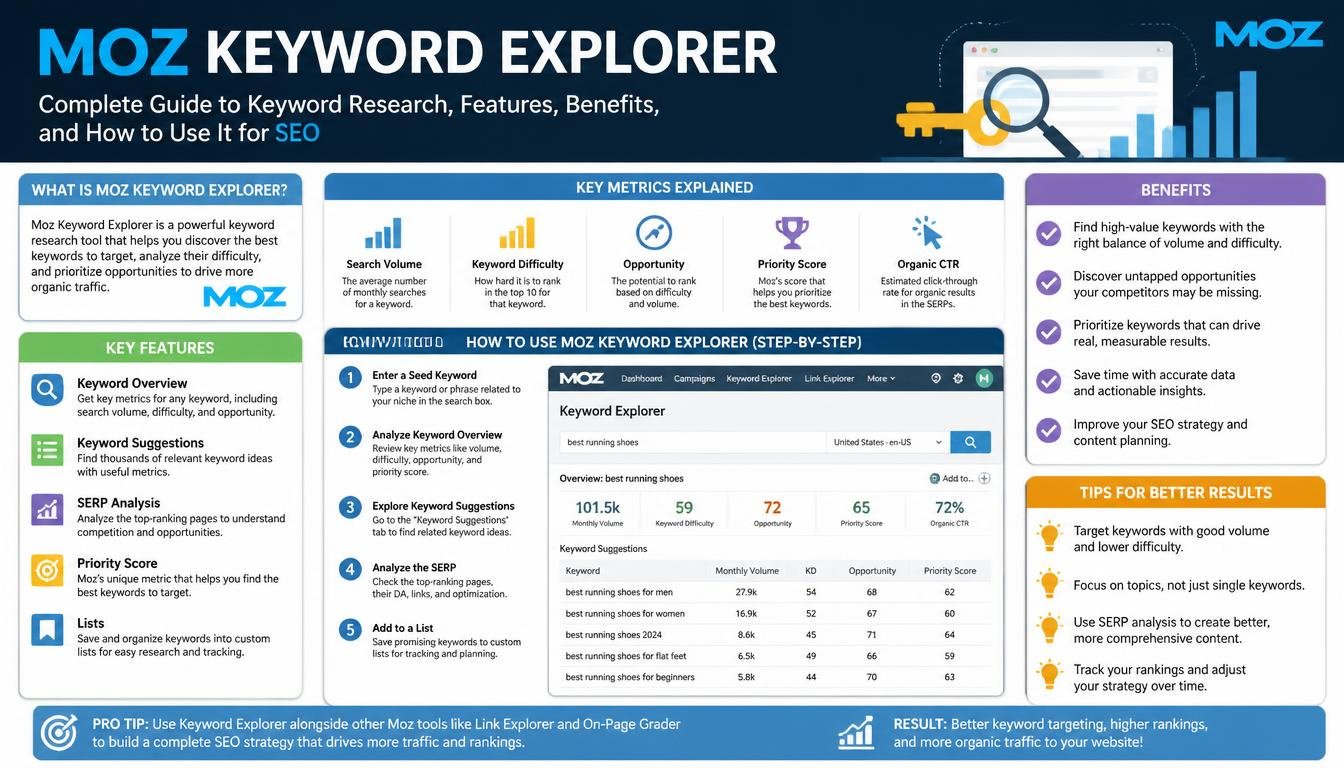
Keyword research is one of the most important parts of search engine optimization because it helps you understand exactly what people are searching for on Google and other search engines. Creating high-quality content without understanding search intent and keyword demand can make it much harder to attract consistent organic traffic. This is where Moz Keyword Explorer can be useful. Moz Keyword Explorer is a keyword research tool designed to help SEO professionals, content creators, bloggers, marketers, and website owners discover keyword opportunities, evaluate search demand, understand keyword difficulty, and identify terms that may be worth targeting in their SEO strategies. Instead of choosing keywords based only on assumptions, you can use keyword data to make more informed decisions about the topics and search terms you want your website to compete for.
Whether you are building a new website, improving an existing blog, launching an ecommerce store, or developing a content marketing strategy, understanding how to perform effective keyword research can significantly improve your chances of reaching the right audience. Moz Keyword Explorer provides several useful metrics and keyword discovery features that can help you move from a general topic to more specific keyword opportunities. In this comprehensive guide, we will explain what Moz Keyword Explorer is, how Moz keyword research works, which metrics you should pay attention to, how to find long-tail keywords, how to analyze keyword difficulty and search volume, and how to use the information to build a practical SEO content strategy.
What Is Moz Keyword Explorer?
Moz Keyword Explorer is an SEO keyword research tool from Moz that helps users discover and evaluate keywords for organic search optimization. The basic idea behind the tool is simple: you enter a keyword or topic, and the platform provides keyword-related information that can help you determine whether a search term is relevant and potentially valuable for your website. Instead of looking at a keyword in isolation, effective keyword research involves considering several factors at the same time, including search volume, competition, difficulty, search intent, potential traffic, and the quality of the pages already ranking for that query. Moz Keyword Explorer is designed to bring many of these considerations together so that marketers can make better keyword targeting decisions.
One of the biggest advantages of using a dedicated SEO keyword tool is that it can reveal opportunities you might not discover through brainstorming alone. For example, a broad keyword may appear attractive because it has substantial search demand, but it can also be extremely competitive. Related long-tail keywords may have lower search volume while being more specific and potentially easier to target. By exploring keyword suggestions and related searches, you can identify different variations of a topic and organize them into a broader content strategy. This makes Moz Keyword Explorer particularly useful when you want to build topical coverage instead of creating individual articles around unrelated keywords.
Why Is Keyword Research Important for SEO?
Keyword research is important because search engines need to understand the subject and purpose of your content, while users need to find pages that accurately answer their questions. A successful SEO strategy therefore begins with understanding the language your target audience uses when searching for information, products, services, or solutions. If your content targets keywords that are unrelated to your audience or have little search demand, even excellent writing may generate limited organic traffic. On the other hand, choosing highly relevant keywords and matching them with the correct search intent can give your content a stronger opportunity to appear in relevant search results.
Good keyword research also helps you understand the competitive landscape before investing significant time in content creation. A keyword with a large search volume can look attractive at first, but if the first page is dominated by highly authoritative websites with exceptionally strong content, ranking for that term may require considerable resources. This does not mean you should automatically avoid competitive keywords. Instead, you can use keyword difficulty, search results, related keyword suggestions, and your own website’s authority to determine which opportunities make the most sense. Moz Keyword Explorer can therefore be used as part of a broader decision-making process rather than as a tool that simply generates a list of keywords.
Moz Keyword Explorer Keyword Research: How Does It Work?
The typical keyword research process begins by entering a seed keyword or topic that is closely related to your website, product, service, or content idea. Moz Keyword Explorer then helps expand that initial idea by providing related keyword opportunities and data that can be used to evaluate those terms. For example, if your website focuses on SEO, you could begin with a broad term such as “SEO tools.” From there, you may discover more specific searches related to keyword research tools, competitor analysis, keyword difficulty, SEO software, long-tail SEO keywords, and other related subjects. This process helps you move beyond the keywords you already know and discover the language and topics that may be relevant to your audience.
The real value comes from evaluating the discovered keywords rather than simply collecting as many as possible. A keyword should ideally be relevant to your business or website, connected to a clear search intent, realistic for your current level of SEO competition, and valuable enough to justify creating high-quality content around it. This is why keyword research should be treated as a filtering and prioritization process. The goal is not to find thousands of keywords and place them randomly throughout your website. The goal is to identify the most useful search opportunities and create content that satisfies the people behind those searches.
Moz Keyword Explorer Search Volume
Search volume is one of the most commonly considered metrics during keyword research because it provides an indication of how frequently people search for a particular term. When evaluating a keyword, search volume can help you estimate the potential size of the audience interested in that topic. However, search volume should never be considered the only factor when selecting keywords. A keyword with a large estimated search volume may attract less valuable visitors than a highly specific keyword with lower search demand but stronger purchase or conversion intent.
For example, imagine that you are selling professional SEO software. A broad keyword such as “SEO” could potentially have enormous search demand, but it does not tell you what the searcher actually wants. Someone searching for “SEO” could be looking for a definition, tutorial, course, agency, software, news, or almost anything else related to search engine optimization. A more specific phrase such as “best SEO keyword research software” provides much more information about the user’s possible intent. Although the search volume may be lower, the keyword could be more commercially relevant. This is why Moz Keyword Explorer search volume should be evaluated alongside relevance, intent, difficulty, and potential business value.
Moz Keyword Explorer Keyword Difficulty
Keyword difficulty is another important concept when performing SEO keyword research. Keyword difficulty attempts to estimate how challenging it may be to rank organically for a particular search term based on the competitive strength of the pages currently ranking for that query. A highly competitive keyword can require stronger website authority, better content, more high-quality backlinks, stronger topical coverage, and a longer-term SEO strategy. A lower-difficulty keyword may provide a more accessible opportunity, particularly for a newer website that has not yet built significant authority.
However, keyword difficulty should not be treated as an absolute ranking prediction. SEO is influenced by many factors, including content quality, search intent, topical relevance, backlinks, internal linking, technical SEO, website reputation, user experience, and the strength of competing pages. A keyword with a favorable difficulty score can still be difficult if the search results contain exceptionally relevant and comprehensive content. Similarly, a keyword with a higher difficulty score may be worth pursuing if it has strong business value and aligns closely with your website’s long-term strategy. The best approach is to use the difficulty metric as a guide and then manually inspect the search results before committing to a keyword.
Moz Keyword Suggestions and Related Keywords
One of the most useful aspects of a keyword research platform is its ability to uncover keyword suggestions. When you start with one seed keyword, there may be dozens, hundreds, or even thousands of related phrases that could represent different questions, needs, and search intents. These suggestions can help you expand your initial topic and discover opportunities that would otherwise be easy to miss. For content marketers, keyword suggestions can also provide ideas for supporting articles, subtopics, FAQs, comparison pages, tutorials, and other types of content.
For example, if your main topic is “Moz Keyword Explorer,” related keyword ideas could include phrases such as “how to use Moz Keyword Explorer,” “Moz keyword research,” “Moz keyword difficulty,” “Moz keyword suggestions,” “Moz SEO tools,” “keyword research with Moz,” and “Moz Keyword Explorer alternatives.” These phrases should not simply be inserted into an article repeatedly. Instead, they can help you understand the broader information users may be looking for. You can then create a comprehensive resource that answers the major questions surrounding the primary topic while naturally addressing related search intents.
How to Find Long-Tail Keywords With Moz Keyword Explorer
Long-tail keywords are longer and usually more specific search phrases that often communicate a clearer user intent than broad keywords. For example, “keyword research” is broad, while “how to do keyword research for a new website” is considerably more specific. Long-tail searches can be valuable because users who type detailed queries often know exactly what information they want. Depending on the keyword and competitive landscape, long-tail phrases may also provide opportunities that are more achievable than highly competitive head terms.
To find useful long-tail keywords, begin with a broad topic and explore related keyword suggestions. Look for phrases that contain questions, specific problems, use cases, comparisons, or clear commercial intent. You should then evaluate whether each keyword is genuinely relevant to your audience and whether you can create a substantially better answer than the pages currently ranking. Rather than creating dozens of thin pages for every variation of a keyword, group closely related phrases together when they represent the same search intent. This approach can help you create stronger, more comprehensive content while avoiding unnecessary keyword cannibalization.
Understanding Search Intent During Keyword Research
Search intent refers to the underlying reason a person performs a particular search. Understanding intent is essential because two keywords that look similar can require completely different types of content. Informational searches generally indicate that the user wants to learn something, while commercial investigation searches often indicate that the user is comparing options or researching a potential purchase. Transactional searches are more directly connected to an action such as buying or signing up, while navigational searches are often used to find a particular website, brand, or page.
When using Moz Keyword Explorer for keyword research, do not select keywords based solely on metrics. Search the keyword yourself and examine the pages appearing in the results. Are the results primarily guides, product pages, category pages, videos, comparison articles, or definitions? The type of content Google displays provides valuable information about what it believes users want. If your planned article does not match the dominant intent, ranking may be difficult even if your content contains the target keyword. Strong SEO content therefore combines keyword data with a careful understanding of search intent.
How to Use Moz Keyword Explorer for Content Planning
Moz Keyword Explorer can be particularly useful when turning keyword research into a structured content plan. Instead of selecting keywords one at a time, you can group related keywords into topical clusters. A primary keyword can serve as the focus of a main article, while closely related searches can become sections within that article or separate supporting articles when they represent distinct search intent. This approach allows a website to build depth around a subject rather than publishing disconnected pieces of content.
For example, a website targeting the broader subject of keyword research could create a pillar article around “keyword research,” followed by supporting resources covering long-tail keywords, keyword difficulty, search intent, competitor keyword research, local keyword research, ecommerce keyword research, and keyword mapping. Each article can link naturally to the others where useful. This creates a logical internal linking structure and gives search engines additional context about the website’s topical expertise. The important point is that content should be organized around users’ needs rather than around an arbitrary number of keywords.
Moz Keyword Explorer and Competitor Research
Competitor research can add another valuable dimension to your keyword strategy. Instead of asking only which keywords you would like to rank for, you can investigate the topics and search terms that competing websites are successfully targeting. This can reveal content gaps, underserved topics, and opportunities where your website could provide a more useful or more specialized resource. Competitor analysis is particularly helpful when you are entering an established niche and need to understand what types of content already perform well.
However, competitor research should not become a copy-and-paste exercise. The objective is to identify opportunities and understand the market, not to reproduce another website’s content. If competing pages all answer the same basic question, you may have an opportunity to create a more comprehensive guide, include original examples, improve the structure, answer unanswered questions, or provide a more useful experience. Keyword research should therefore inform your content strategy while originality, expertise, usefulness, and quality remain central to the final article.
How to Choose the Best Keywords From Moz Keyword Explorer
Choosing the best keywords requires balancing several factors rather than chasing the highest search volume. Start by asking whether the keyword is directly relevant to your website and whether ranking for it could attract the type of visitor you actually want. Next, consider search intent. If the keyword attracts people who are looking for something different from what your website provides, it may not be valuable even if the search volume is impressive. After relevance and intent, examine competition and keyword difficulty to determine whether the opportunity is realistic for your website.
You should also consider the potential value of the traffic. A keyword with modest search volume can sometimes be far more valuable than a high-volume keyword because it attracts users who are closer to taking an important action. For example, a highly specific product-related search may generate fewer visitors but produce more qualified leads or sales than a broad informational query. This is why effective Moz keyword research is ultimately about finding the right visitors, not simply generating the largest possible number of visitors.
Common Mistakes to Avoid When Using Moz Keyword Explorer
One common mistake is selecting keywords solely because they have high search volume. High-volume keywords often attract significant competition and may have broad or unclear search intent. Another mistake is targeting every keyword variation with a separate article. When several keywords represent essentially the same search intent, creating multiple pages can result in overlapping content and make it harder to build a clear site structure. Instead, consider whether one comprehensive page can naturally satisfy several closely related searches.
Another mistake is relying too heavily on keyword metrics without looking at the actual search results. Keyword difficulty and search volume are useful indicators, but they cannot replace human analysis. Search Google for the keyword and examine the quality, format, depth, and authority of the pages ranking on the first page. Look for weaknesses that your content can genuinely address. You should also avoid keyword stuffing. Repeating “Moz Keyword Explorer” unnaturally throughout an article does not make the content better. Use the primary keyword where appropriate and naturally incorporate related terminology when it helps readers understand the subject.
Moz Keyword Explorer for Beginners
For beginners, the easiest way to approach Moz Keyword Explorer is to start with a topic you already understand rather than immediately trying to discover thousands of keywords. Enter a broad seed keyword that represents your product, service, or content area and examine the related keyword opportunities. Pay attention to terms that are highly relevant, specific enough to communicate intent, and realistic for your website. Create a shortlist rather than attempting to use every keyword the tool provides.
Once you have your shortlist, organize the keywords according to intent and topic. Some terms may belong on informational blog posts, others may be suitable for product or service pages, and others may work better as supporting resources. Then prioritize the opportunities according to their relevance, potential value, competition, and your ability to create substantially better content. This simple process prevents keyword research from becoming overwhelming and helps you turn keyword data into an actionable SEO plan.
Is Moz Keyword Explorer Good for SEO?
Moz Keyword Explorer can be a useful part of an SEO workflow because it combines keyword discovery with metrics that help users evaluate potential opportunities. It can be especially helpful for marketers who want to move beyond basic keyword brainstorming and develop a more structured research process. The tool can help identify related searches, explore keyword opportunities, understand competitive difficulty, and support content planning.
That said, no keyword research tool should be treated as a complete SEO strategy by itself. Successful organic search performance depends on many additional factors, including content quality, technical SEO, website architecture, internal links, backlinks, user experience, topical authority, and the degree to which a page satisfies search intent. Moz Keyword Explorer is best viewed as a research and decision-support tool that contributes to a larger SEO process rather than a shortcut to Google rankings.
Moz Keyword Explorer vs. Basic Keyword Research
Basic keyword research often involves brainstorming phrases, checking Google suggestions, and selecting terms based on personal assumptions. While these methods can generate useful ideas, they provide limited insight into the competitiveness and potential value of individual keywords. A dedicated keyword research platform can make the process more systematic by giving you additional data and helping you discover related opportunities.
The important difference is not simply the number of keywords a tool can generate. The real benefit comes from being able to evaluate opportunities more intelligently. Instead of asking, “What keyword should I put in this article?” you can ask, “Which search terms are relevant to my audience, what intent do they represent, how competitive are they, what type of page should target them, and how can I create a better result?” That shift in thinking is what makes professional keyword research more valuable than simply collecting keyword lists.
How to Build an SEO Strategy With Moz Keyword Explorer
A practical SEO strategy can begin by defining your main business topics and entering them into Moz Keyword Explorer as seed keywords. From the resulting ideas, identify terms that are closely connected to your products, services, or audience needs. Group similar keywords into topic clusters and determine which keywords should be primary targets and which should be supporting terms. Then evaluate the competitive landscape and prioritize topics where you have a realistic opportunity to create valuable content.
After publishing, SEO should not stop. Monitor how pages perform, identify queries that generate impressions or traffic, and look for opportunities to improve existing content. An article may initially target one primary keyword but eventually receive impressions for many related searches. Those additional queries can reveal questions that deserve clearer answers or sections that could be expanded. Keyword research is therefore not a one-time activity; it can become part of an ongoing process of content improvement and search optimization.
Tips for Getting Better Results From Moz Keyword Explorer
The first tip is to start with topics rather than obsessing over individual keywords. Think about the problems your audience needs to solve and the questions they are likely to ask. Use those topics as seed ideas and let keyword research reveal the language associated with them. This approach produces a more natural content strategy and reduces the temptation to force keywords into articles.
The second tip is to prioritize relevance and intent before volume. A smaller keyword that precisely matches your audience can be more valuable than a broad keyword that attracts visitors who are unlikely to engage with your website. The third tip is to study the actual search results before creating content. Look at what Google is currently rewarding and determine how your proposed page can be more useful, more complete, clearer, or more authoritative. Finally, use related keywords naturally throughout your content rather than repeating the same phrase excessively.
Conclusion
Moz Keyword Explorer can be a valuable resource for anyone who wants to make keyword research more systematic and data-informed. Instead of choosing keywords based only on intuition, you can use keyword discovery, search volume, difficulty, related terms, and search intent to identify opportunities that better match your audience and SEO goals. The most effective approach is not to chase every keyword with high search volume but to find terms that are relevant, valuable, realistic, and connected to content you can create exceptionally well.
Ultimately, keyword research is only the beginning of successful SEO. The data you discover through a tool such as Moz Keyword Explorer becomes valuable when you turn it into useful content, logical website architecture, strong internal linking, excellent user experience, and a consistent strategy for improving your pages. If you combine keyword research with genuine expertise and content that satisfies search intent better than competing pages, you can build a stronger foundation for long-term organic visibility. Rather than treating Moz Keyword Explorer as a tool for generating keyword lists, use it as a way to understand what your audience is searching for and to make smarter decisions about what your website should create next.
Frequently Asked Questions About Moz Keyword Explorer
What is Moz Keyword Explorer used for?
Moz Keyword Explorer is primarily used for keyword research and SEO planning. It helps users discover keyword opportunities, investigate related searches, evaluate metrics such as search volume and difficulty, and identify terms that may be suitable for their websites and content strategies.
Is Moz Keyword Explorer free?
Moz provides access to its SEO tools through its own plans and offerings, with availability and limits depending on the current account or subscription. Because pricing, features, and usage limits can change, it is best to check Moz’s current official offering before choosing a plan.
What is keyword difficulty in Moz?
Keyword difficulty is an estimate of how challenging it may be to rank for a particular keyword based on the competitive strength of the search results. It should be treated as a useful indicator rather than a guarantee of whether a page will rank.
How do I find long-tail keywords in Moz Keyword Explorer?
Start with a broad seed keyword and explore related keyword suggestions. Look for longer, more specific phrases that clearly communicate a question, problem, use case, or intent. Then evaluate their relevance and competition before deciding whether they deserve their own page or should be incorporated into a broader article.
Is Moz Keyword Explorer good for beginners?
Yes. Beginners can use it to learn how keyword research works and understand concepts such as search volume, keyword difficulty, related keywords, and search intent. The most important skill, however, is learning how to interpret the data rather than simply collecting keyword suggestions.
Can Moz Keyword Explorer help with content ideas?
Yes. Keyword suggestions can reveal questions, topics, and variations that can be used to develop blog posts, guides, FAQs, landing pages, and supporting content. The best content ideas combine keyword data with real audience needs and search intent.
Should I target high-volume keywords?
Not necessarily. High-volume keywords can be valuable, but they are often more competitive and may have broad search intent. A highly relevant lower-volume keyword can sometimes generate more valuable traffic, particularly when it has strong commercial or transactional intent.
How often should I do keyword research?
Keyword research should be performed when developing a new SEO strategy, planning major content campaigns, entering new topics, and updating existing content. It can also be revisited periodically because search behavior, competitors, and your website’s priorities can change over time.
Red Angus Cow: Breed Characteristics, Benefits, Care, and Beef Production
Flooding in Auburn WA: Causes, Risks, Safety Tips, and How to Prepare
2025 Mazda CX-90 PHEV: Specs, Range, Price, Features and Complete Review

POCSO Case: Complete Guide to the Protection of Children from Sexual Offences Act, Procedure, Punishment, Rights, and Legal Process

Persona 5 Royal Fusion Calculator: The Ultimate Guide to Perfect Persona Fusion

TPE: 2317 – Complete Guide, Features, Applications, Benefits, and Specifications
 Politics3 months ago
POCSO Case: Complete Guide to the Protection of Children from Sexual Offences Act, Procedure, Punishment, Rights, and Legal Process
- Uncategorized3 months ago
Persona 5 Royal Fusion Calculator: The Ultimate Guide to Perfect Persona Fusion
- Uncategorized3 months ago
TPE: 2317 – Complete Guide, Features, Applications, Benefits, and Specifications
- Business3 months ago
Mietmakler: The Complete Guide to Rental Brokers, Benefits, Costs, and Finding the Perfect Rental Property
- Celebrity3 months ago
Jimmy Harrell: Biography, Career, Achievements, Legacy, and Interesting Facts
- News3 months ago
AC Breaking News: Latest Headlines, Breaking Stories, Live Updates, and Trending News
- Lifestyle3 months ago
Marshall Tools Bricky: The Complete Guide to Professional Bricklaying Tools
- Entertainment3 months ago
Star Wars Movie FX Maker Codes: Complete Guide to Unlock Effects, Characters, and Hidden Features